
Hotel vs Airbnb: Which Should You Choose in 2026?
Picking between a hotel and an Airbnb used to be simple: Airbnb meant cheaper and more local, hotels meant pricier and predictable. That math doesn’t hold anymore. In 2026, roughly half of US travelers still say they trust hotels more — yet Airbnb keeps growing its share of family and group trips. The real answer depends on your group size, your trip length, and how you feel about doing your own dishes. Below, we run the actual numbers so you don’t have to guess.

Key takeaways
- For 1-2 night solo trips, hotels are usually cheaper once fees are included.
- For 3+ nights or groups of 2 or more, Airbnb usually wins — the cleaning fee stops mattering.
- Always compare the all-in total at checkout, not the headline nightly rate.
- Hotels win on service and last-minute flexibility; Airbnb wins on space and long stays.
Hotel vs Airbnb at a Glance
| Factor | Hotel | Airbnb |
|---|---|---|
| Best for | Solo trips, 1-2 nights, business travel | Groups, families, stays of 3+ nights |
| Pricing style | Higher nightly rate, resort fees possible | Lower nightly rate + one-time cleaning fee |
| Consistency | High — same standard everywhere | Variable — depends on the host |
| Service | Front desk, daily housekeeping, concierge | Self-service, host contact only |
| Space | One standard room (~300 sq ft) | Often a full apartment or house |
| Cancellation | Usually flexible, free up to 24-48h | Set by host, often stricter |
What Is a Hotel?
A hotel is a commercial property built and staffed specifically for short-term stays. Rooms are standardized, service is professional, and you typically have access to shared amenities like a lobby, restaurant, gym, or pool. Because hotels operate under brand standards, you generally know what to expect before you arrive.
What Is Airbnb?
Airbnb is a platform connecting travelers with hosts renting private rooms, apartments, or entire homes. There’s no shared staff or standardized service — the experience depends entirely on the host, from communication style to how accurately the listing matches reality.
The Simple Version
Strip away the jargon and it comes down to this: a hotel is renting one tidy room with a front desk — someone makes your bed and is downstairs if anything breaks. Great for one or two people, one or two nights. An Airbnb is renting someone’s whole home — bedrooms for everyone, a kitchen, a living room. Great for a group or a longer stay, overkill for one person crashing for one night. The rule of thumb: more people or more nights, lean Airbnb; solo and short, lean hotel.

Real Cost Comparison: A 4-Night Family Trip
Ranges are useful, but the decision gets obvious once you price a real trip. Meet Laura, planning a 4-night trip for a family of four to a mid-size US city. A family of four doesn’t fit in one hotel room, so the honest comparison is two rooms.
Hotel option (2 rooms, 4 nights):
- Room rate: $180/room/night × 2 rooms × 4 nights = $1,440
- Occupancy tax (12%): $172.80
- Resort fee ($15/room/night × 2 × 4): $120
- Hotel total: $1,732.80
Airbnb option (one 2-bedroom unit, 4 nights):
- Nightly rate: $160 × 4 nights = $640
- Cleaning fee (one-time): $95
- Occupancy tax (12% of $640): $76.80
- Airbnb total: $811.80
Laura’s family saves $921 by booking the Airbnb — before counting what they’d save by cooking two or three meals a day instead of eating out. That gap is exactly why families and groups skew toward Airbnb once you’re past 3 nights.
The Tipping Point: When Does Airbnb Actually Get Cheaper?
The family example above is lopsided because two hotel rooms are expensive. The more useful question is: for a solo traveler in one room, at what point does Airbnb’s cleaning fee stop being a disadvantage?
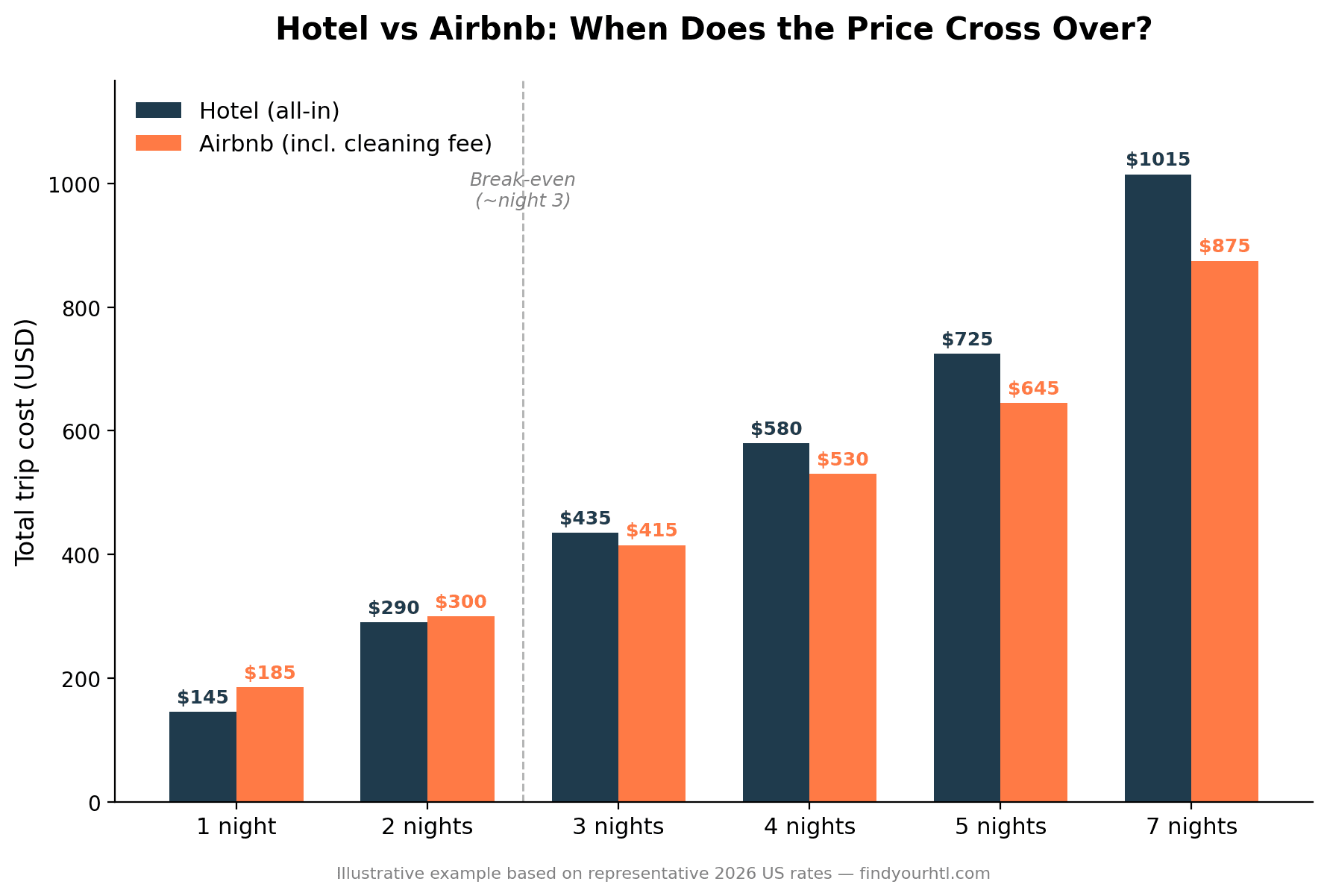
| Nights | Hotel total (all-in) | Airbnb total (incl. cleaning fee) | Cheaper option |
|---|---|---|---|
| 1 | $145 | $185 | Hotel |
| 2 | $290 | $300 | Hotel |
| 3 | $435 | $415 | Airbnb |
| 4 | $580 | $530 | Airbnb |
| 5 | $725 | $645 | Airbnb |
| 7 | $1,015 | $875 | Airbnb |
The crossover lands around night three. Below that, the fixed cleaning fee outweighs the lower nightly rate. Past it, the fee gets diluted across more nights and Airbnb pulls ahead. (Figures above are an illustrative model based on representative 2026 US rates — run your own numbers for your dates and destination.)
Want to check real rates for your trip? Compare hotel prices for your dates on Booking.com.
Myth-Busting: What Travelers Get Wrong
Myth: “Airbnb is always cheaper.”
Reality: Only past the 3-night mark, as the table above shows. For a 1-night solo stay, hotels usually win once the cleaning fee is added.
Myth: “The nightly rate is what you’ll actually pay.”
Reality: Rarely. Hotels add resort fees, parking, and taxes. Airbnb adds a cleaning fee and, in some cases, a service fee. Always check the total at checkout, not the search-results price.
Myth: “Hotels are always the safer, more reliable option.”
Reality: A well-reviewed, professionally managed Airbnb can match hotel-level cleanliness and responsiveness. The reliability gap depends entirely on the specific host — check recent reviews and response rate before booking.
Space, Amenities & Safety
Space and Comfort
This is where Airbnb usually wins. A one-bedroom apartment gives you a separate living area, a real kitchen, and often laundry — space that would cost far more in an equivalent hotel suite.
Amenities and Services
Daily housekeeping, a 24-hour front desk, and a concierge are standard at most hotels. With Airbnb you’re on your own — mid-stay cleaning is rare, and if something breaks, you’re messaging a host who may not be nearby. On the flip side, most Airbnb listings have a real kitchen, which few hotel rooms offer.
Safety and Consistency
Hotels offer a predictable safety baseline: staffed lobbies, regulated operations, and accountability as a licensed business. Airbnb safety varies by listing — reviews, host verification, and photos become your due-diligence tools. Neither option is inherently unsafe, but hotels require less research to trust upfront.
When Hotels Win
- Solo travelers, short trips: One or two nights for a meeting or event — a hotel wins on convenience and total cost.
- Business travel: Clean, itemized receipts, easy expensing, and loyalty points on corporate cards.
- Last-minute bookings: Hotels offer same-day availability and often free cancellation up to the day of arrival. Most Airbnb hosts need 24-48 hours notice.
- When you want real service: Room service, a concierge, a bellhop — hotels deliver this in ways an individual host can’t.
- Loyalty program payoff: If you’re close to a free night or elite status, staying on-brand makes financial sense even at a premium rate.
When Airbnb Wins
- Families with children: Multiple bedrooms, a kitchen, and a living room make family travel easier and cheaper.
- Long stays (5+ nights): The one-time cleaning fee becomes a small fraction of the total cost.
- Groups of 4 or more: One large Airbnb almost always beats three separate hotel rooms.
- Remote work stays: A dedicated workspace, kitchen, and laundry make Airbnb the default for extended trips.
- Pet owners: More pet-friendly listings, often without the $50-150 per-stay surcharge hotels charge.
3 Mistakes Travelers Make Choosing Between Them
- Comparing headline rates, not all-in totals. A $110 Airbnb looks cheaper than a $145 hotel room until fees and taxes are added — on a single night, it can end up more expensive.
- Booking an Airbnb for one night. The cleaning fee is a fixed cost, so it punishes short stays hardest. If you’re staying one or two nights solo, price a hotel first.
- Ignoring host reviews and response rate. The biggest variable in an Airbnb stay isn’t the photos — it’s who runs it. Read recent reviews before booking.
Booking and Cancellation Policies
Hotels generally offer more flexible cancellation, with many rates fully refundable up to 24-48 hours before arrival. Airbnb cancellation policies are set by each host and range from flexible to strict — always check this before booking, especially if your dates aren’t fixed.
Final Verdict: Which Should You Choose?
There’s no universal winner — it depends on your trip:
- Choose a hotel if: you’re traveling solo or for business, staying 1-2 nights, or want predictable service without extra research.
- Choose Airbnb if: you’re traveling with a group or family, staying 3+ nights, or want a kitchen and more space than a standard room offers.
- Use both strategically: many travelers default to hotels for quick trips and Airbnb for leisure and group travel — there’s no penalty for switching depending on the trip.
Ready to compare real prices for your dates? Search hotel availability on Booking.com and see how it stacks up against local Airbnb listings before you book.
Frequently Asked Questions
Is Airbnb cheaper than a hotel?
Usually only past 3 nights. For 1-2 night solo trips, hotels tend to be cheaper once the cleaning fee is factored in.
Is Airbnb safer than a hotel?
Both can be safe. Hotels offer more consistent safety standards since they’re staffed and regulated. Airbnb safety depends on the specific host — check reviews and verification first.
Do hotels still make sense with Airbnb around?
Yes — for short stays, business travel, and solo trips, hotels remain the more convenient and often cheaper option.
What’s the biggest hidden cost with each option?
For hotels, it’s resort fees and parking. For Airbnb, it’s the cleaning fee — always check the total at checkout, not the nightly rate.
Can you negotiate prices with Airbnb hosts?
Sometimes, especially for longer stays. Hotels rarely negotiate directly, but comparison sites can surface lower rates for the same room.
Is an Airbnb better for a family vacation?
In most cases, yes — a 2-bedroom unit with a kitchen beats booking two hotel rooms on both price and convenience for trips of 3+ nights.